

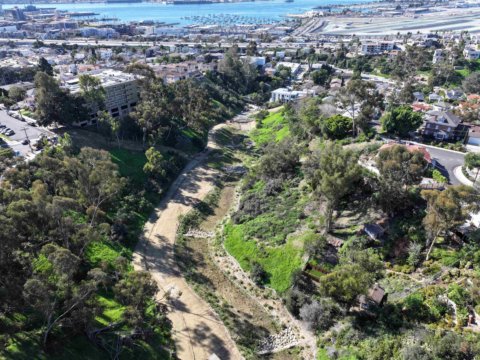
For decades, Maple Canyon has remained a well-used community park in a natural canyon in the heart of San Diego’s Bankers Hill neighborhood.
The canyon was the surrounding area’s natural drainage channel, but over time aging and undersized storm drains began to wear down the original function. Eventually, erosion led to larger environmental concerns and safety issues, sending sediment and pollutants downstream to San Diego Bay and significantly affecting the local ecosystem.
The Challenge
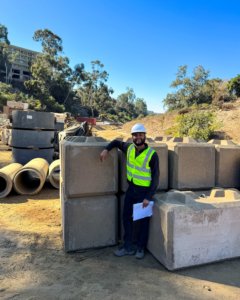 What began as small drainage issues grew into a system-wide failure that could no longer be addressed with a few repairs. The scale of the damage required a comprehensive overhaul, and RICK partnered with the City of San Diego on a multi-phase restoration to rebuild the canyon’s infrastructure and stabilize it long term.
“There’s always a careful balance on a project like this. You’re dealing with infrastructure issues that need durable solutions, but you’re also working in a place that people feel connected to, so every decision must consider both sides. We spent a lot of time making sure the canyon’s infrastructure was functioning properly while still feeling like the familiar neighborhood canyon and trail when the work was done.” —Ash Paranthaman, PE, Water Resources Manager at RICK
Construction and Access
 When the canyon was evaluated, it was found that 16 failing storm drain systems required redesign and replacement, along with the need for a new 48-inch storm drain to prevent runoff and sediment flooding along West Maple Street.
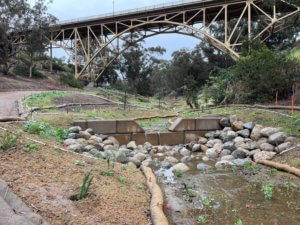
To address erosion and repeated storm damage, the canyon floor was stabilized using precast grade control structures placed along the channel to slow runoff and reduce further degradation. Naturally colored and shaped stone rip rap was installed at each structure and at outfalls to manage flow while maintaining the canyon’s natural appearance, and native vegetation was planted within the channel to reinforce stability over time.
The Maple Canyon Trail was also widened, and two pedestrian bridges were added to improve access for the community that uses it every day.
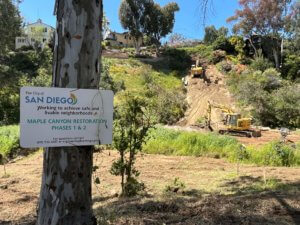 The steep and narrow urban canyon complicated construction and limited access during the project. Site entry had to be carefully coordinated with surrounding properties, and the Maple Canyon Trail was used to provide as much construction access as possible.
Construction is nearing completion, with work continuing through April 2026.
Restoring Drainage and Community Use
Maple Canyon functions as the main drainage route for the surrounding neighborhood. The canyon collects runoff from more than 100 acres through multiple storm drain systems, all emptying into the same narrow channel before continuing downstream toward San Diego Bay. Reestablishing the canyon’s drainage function required coordination between many different partners, with the RICK team and the City of San Diego working alongside state and federal resource agencies to navigate permitting and funding requirements while keeping the surrounding community informed. The work has strengthened the canyon so that it is resilient during storms while still remaining the familiar neighborhood park the community relies on every day.
“The goal was to restore the canyon’s natural function rather than continue adding layers of infrastructure. By slowing water down and allowing the landscape to recover, the system became more resilient over time and now requires less intervention after major storms. That long-term stability is the measure of success for a project like this.” —Shavger Rekani, Associate Principal, RICK
Maple Canyon was featured by Stormwater Solutions Magazine as a 2025 Top Project and received multiple awards for its integrated approach to flood control, water quality, and ecological restoration, with the canyon considered a model for how urban infrastructure and natural systems can work together.
Maple Canyon’s transformation strengthens the canyon for the long term, improving safety and restoring the canyon as a resilient and integral part of the Bankers Hill community.